
Local governments make decisions every day about growth, land use, infrastructure, and public services. Elected leaders grapple with decisions on the balance of land uses that will continue to provide local tax revenues to support public services. A Cost of Services Study provides perspective by comparing the revenues generated by residential, commercial/industrial, and agricultural land uses with the cost of providing public services to each. Rather than suggesting that one type of development is “good” or “bad,” the analysis gives elected officials and staff a clearer understanding of the fiscal relationships among land uses and helps inform decisions about growth, development, and the long-term financial sustainability of the community.
Creative EDC uses the American Farmland Trust approach, a national best-practice model, to analyze how much revenue different land uses generate for local governments and how much those land uses cost in public services. The approach analyzes a local government’s budget and allocates revenues and expenditures to three broad land-use categories: residential, commercial/industrial, and agriculture. Revenues typically include property taxes and other locally generated revenues. Expenditures include major public services such as schools, public safety, social services, administration, and other general government functions. These revenues and costs are then assigned to land-use categories using assessed property values, service demand indicators, or proportional allocation methods based on local data.
Studies done across the country using the American Farmland Trust model have found that residential development has a ratio, or financial return, of less than one. An example is that for every dollar a local government spends on residential land use, $0.70 is returned in revenue. Commercial/industrial has a ratio greater than one, meaning that for every dollar a local government spends on this land use it may receive, as an example, $4 in revenue. Agriculture is also a net positive to local governments.
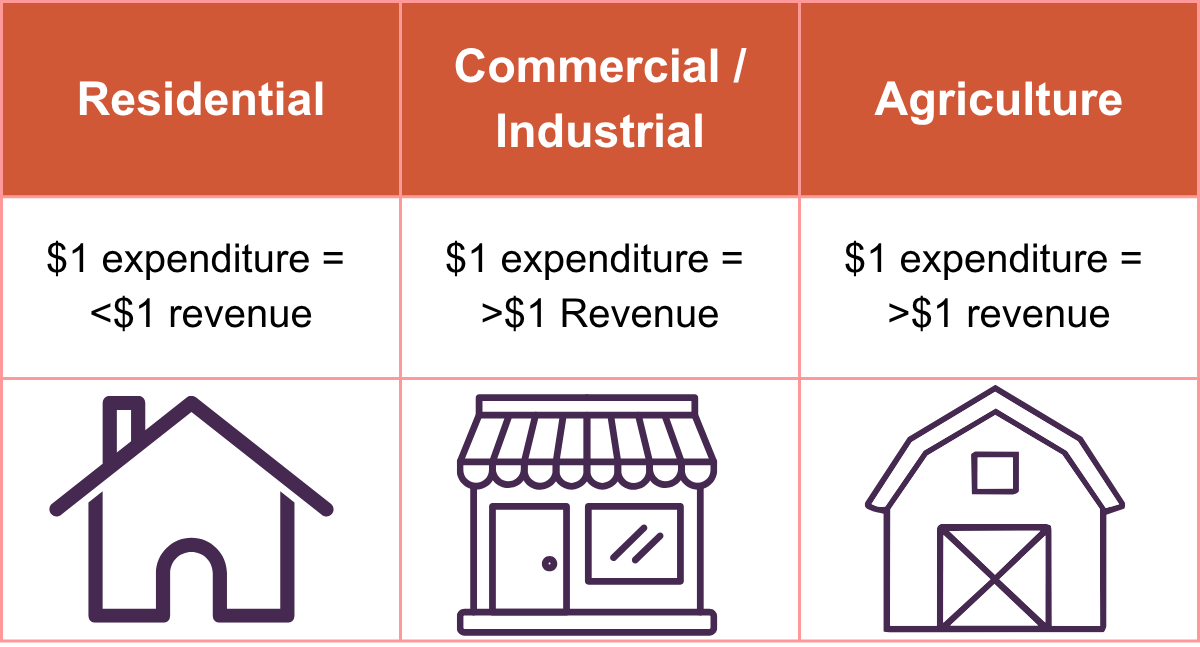
It is important to point out that this analysis does not consider the intangible or social value of land uses and the interdependence of land uses. Commercial developments need workers, who need a place to live and want places to recreate. Greenways and trails attract residents who spend money at businesses, who then hire workers. Through economic activities, land uses are connected.
If your local government staff and leaders are struggling with land use policy and decisions, consider conducting a Cost of Services study to provide one perspective on the return of different land uses. However, put the analysis in the context of the community’s overall goals for a balanced, quality place.